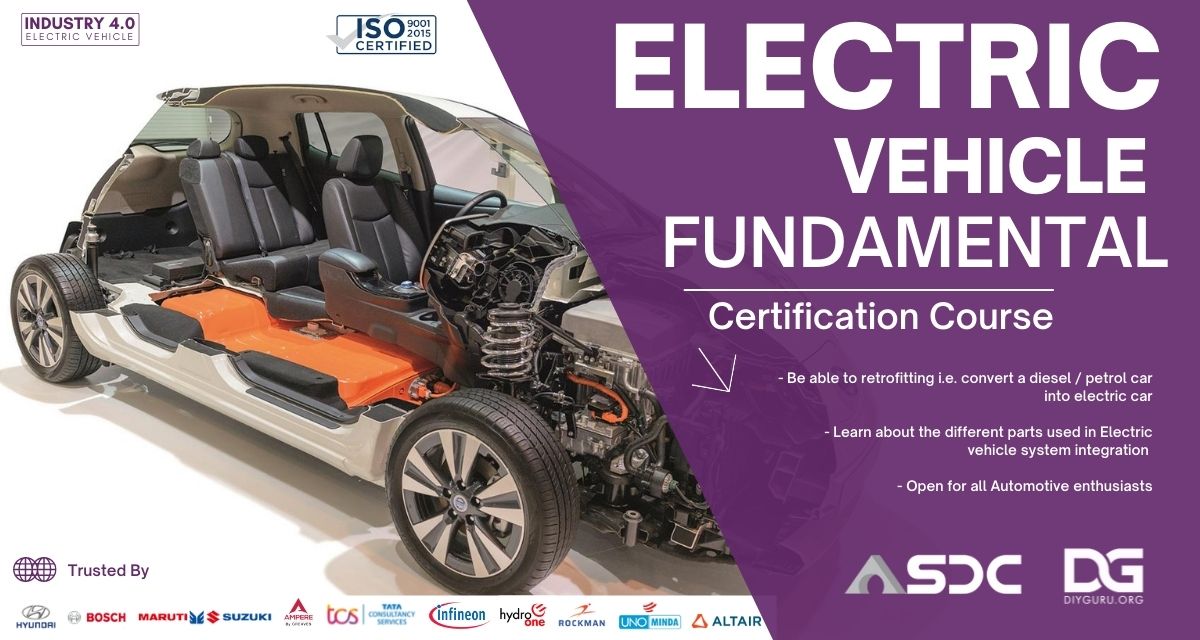
DIYguru has prepared a one-of-a-kind certification course on Electric Vehicle of 90 Days in partnership with E-Mobility companies. Our programs have been recognized and availed by Robert Bosch, Suzuki, and Hyundai to the name of a few.
₹10,000.00Original price was: ₹10,000.00.₹7,500.00Current price is: ₹7,500.00.
Did you just search for an Electric Vehicle Course in India? Good news — you are right on time. India's EV industry just closed its biggest year ever. In fact, FY2026 EV sales crossed 24.52 lakh units (FADA data, April 2026). Moreover, sales grew 24.6% year-on-year, with every major segment posting double-digit growth.Here is the bigger picture. The Ministry of Skill Development and Entrepreneurship projects that India's EV sector will create 1 crore direct jobs by 2030. Additionally, the same projection forecasts 5 crore indirect jobs across the value chain. So one factor will decide whether you grab one of those jobs — the Electric Vehicle Course you choose right now.This guide answers every question you could ask about an Electric Vehicle Course. Are you a B.Tech student? A working professional planning to switch from ICE to EV? A Diploma or ITI holder hunting for an EV technician course? An entrepreneur trying to crack the EV business? Whatever your background, you will find your answer below. Furthermore, we have organised it the way Google likes to read it — and the way you actually want to learn.DIYguru runs India's largest ASDC-certified Electric Vehicle Course. So far, we have trained 50,000+ professionals across 170+ countries. The Electric Vehicle Course carries multiple recognitions. First, ASDC (Automotive Skills Development Council, Government of India). Second, AICTE NEAT (National Educational Alliance for Technology). Third, NSDC (National Skill Development Corporation). In addition, the Ministry of Education and NITI Aayog also recognise DIYguru. Therefore, every claim in this guide comes from real experience — placing thousands of EV learners at companies like Tata Motors, Bosch, Hyundai, Mahindra Electric, Ola Electric, Ather Energy, Hero Electric, and JBM Auto.
What Exactly Is an Electric Vehicle Course?
The Short Definition
An Electric Vehicle Course is a structured training programme. It teaches you how to design, build, run, and service electric vehicles. In short, it covers everything from battery cells to vehicle software.First, the syllabus tackles high-voltage battery packs. Next, it covers Battery Management Systems (BMS). Then it moves to electric motors, power electronics, and charging infrastructure. Finally, it ends with the safety rules that govern high-voltage electrical systems. Notably, this is very different from a traditional automotive course. A regular auto course teaches the petrol or diesel engine. An Electric Vehicle Course, on the other hand, teaches the technologies that replace it.
Why an Electric Vehicle Course Is Different from a Generic Engineering Course
Here is the key point. The EV ecosystem demands a multi-discipline skill set. No single conventional engineering branch fully prepares you for it. Therefore, a good EV Course bridges five separate fields.First, electrical engineering — for motors and inverters. Second, mechanical engineering — for vehicle dynamics, packaging, and thermal design. Third, chemical engineering — for battery cell chemistry. Fourth, software engineering — for BMS firmware and vehicle control. Finally, electronics engineering — for sensors, controllers, and protocols like CAN and LIN. As a result, EV professionals are in short supply. The previous generation of automotive engineers simply never trained across all these fields.
DIYguru's Practical Learning Approach (PLA Model)
DIYguru's Electric Vehicle Course follows the Practical Learning Approach. We call it the PLA model. In simple terms, you do not just watch lectures. Instead, every concept gets reinforced through workshop prototypes, real EV components, and simulation work in tools like MATLAB Simulink.Moreover, the course ends with a project-based internship. This produces a portfolio piece you can actually show recruiters. As a result, even a 12th-standard student or a non-engineer can build industry-grade EV skills in weeks — not years.
Who Should Take an Electric Vehicle Course?
Here is the most-asked question. Is the Electric Vehicle Course right for me? Honestly, the EV industry is one of the most inclusive sectors in modern Indian engineering. There are roles for graduates and non-graduates. Likewise, there are roles for technical and non-technical professionals. So whether you are a student or a senior career-switcher, the course meets you where you are.
Engineering Graduates and Students (B.E. / B.Tech)
Are you doing or have you completed a B.E. or B.Tech? Then this course adds the EV-specific skills your degree alone does not give you. It does not matter which branch you chose — Mechanical, Electrical, ECE, Automobile, Mechatronics, CSE, Civil, or Chemical. The Electric Vehicle Course works for all of them.Importantly, the curriculum reflects what EV employers actually hire for. It does not just repeat what college syllabi teach. So engineering students typically join for one of three reasons. First, to land their first EV job. Second, to switch from a non-EV role. Third, to add an EV credential before campus placements begin.
Diploma and ITI Holders
Diploma holders in Mechanical, Electrical, Automobile, or Electronics engineering are a perfect fit for the EV industry. Likewise, ITI holders in motor mechanic, electrician, electronic mechanic, or automotive trades are highly valuable. Why? Because India is rapidly scaling its EV service network across cities and towns.So the Electric Vehicle Course turns a generic Diploma or ITI qualification into a specialised, job-ready EV technician profile. As a result, companies like Tata Motors, Mahindra Electric, Ola Electric, and the booming EV service chains hire these graduates aggressively.
Working Professionals from ICE / Conventional Automotive
Do you currently work in the conventional ICE automotive industry? Maybe at an OEM, a Tier-1 supplier, a dealership, a service centre, or any auto-component company? Then your career is already on a transition curve. The OMI Foundation analysed 35 EV job categories. Their finding: only one-third of these jobs use skills that overlap with traditional ICE roles.So the other two-thirds need entirely new skills. We are talking about battery chemistry, power electronics, BMS firmware, thermal management, and charging infrastructure. Therefore, the Electric Vehicle Course helps ICE professionals upskill while they continue working. Weekend classes, recorded sessions, and a self-paced format make this possible without quitting your current job.
BBA, MBA, Arts, and Commerce Graduates
The EV industry is not just for engineers. EV companies also need product managers, business development executives, EV sales specialists, marketing professionals, supply-chain managers, financial analysts, policy researchers, and entrepreneurs.So if you have a BBA, MBA, B.Com, B.A., or any non-engineering qualification, this course gives you the technical fluency you need. To be clear, you will not become an EV engineer. However, you will become an EV-aware professional. As a result, you can sell EVs, market EVs, fund EVs, manage EV operations, or start an EV business — all with credibility.
Senior Secondary Students (Class 11 and 12)
Are you in Class 11 or 12? Then this Electric Vehicle Course is one of the smartest pre-college investments you can make. Most engineering aspirants enter B.Tech blind. They pick branches based on past prestige rather than future opportunity.Doing an EV Course before college solves three problems at once. First, it helps you pick the right engineering branch — Mechanical, Electrical, ECE, or Automobile — based on your EV career goals. Second, it gives you a credential that strengthens your college applications. Third, it lets you start engineering already familiar with industry vocabulary and tools.
Automotive Enthusiasts and Self-Taught Mechanics
DIYguru's Electric Vehicle Course has no mandatory academic prerequisites for automotive enthusiasts. So if you grew up around vehicles, worked in a garage, or self-taught yourself through YouTube, this course is open to you.In fact, many of our most successful alumni came from non-traditional backgrounds. They understood vehicles intuitively. However, they needed structured training to formalise that knowledge into employable EV credentials. Bottom line — the course meets you where you are.
Working Professionals Outside Automotive
Do you work in R&D, product analysis, project management, maintenance, or component design? Maybe in power electronics, consumer electronics, energy storage, renewable energy, semiconductors, industrial automation, or even aerospace? Then your existing skills transfer remarkably well into EV roles. Therefore, the Electric Vehicle Course bridges the EV-specific knowledge gap quickly.
Motor Insurance and Vehicle Assessment Professionals
This is an under-discussed but rapidly growing audience. Motor insurance companies, vehicle assessors, surveyors, and claims professionals urgently need EV-specific knowledge. They have to evaluate claims involving electric two-wheelers, three-wheelers, four-wheelers, and heavy commercial EVs.Importantly, EV repair economics, battery damage assessment, and accident analysis differ entirely from ICE vehicles. So the Electric Vehicle Course gives insurance and assessment professionals the technical understanding they need. As a result, they can do their job correctly in an EV-dominated future.
Aspiring EV Entrepreneurs and Business Owners
India already has 400+ active EV startups. Furthermore, the EV ecosystem raised over USD 1.4 billion in funding in 2025 alone. Are you planning to start an EV-related business? Maybe in manufacturing, retail, charging stations, battery swapping, fleet operations, last-mile delivery, components, or repair services?Then the Electric Vehicle Course is the fastest way to build technical credibility. With this credibility, you can raise funding more easily. You can recruit a strong team. You can negotiate intelligently with suppliers. Most importantly, you can operate confidently in the EV market.
Complete Curriculum — What You Will Learn
The DIYguru Electric Vehicle Course covers every domain an EV professional needs. We designed the curriculum with input from senior industry advisors. Moreover, we update it continuously based on live hiring data from our 300+ partner companies. So what you learn today is exactly what employers interview for tomorrow.
Module 1 — Lithium-Ion Battery Technology
The battery is the most expensive part of any electric vehicle. In fact, it accounts for 35% to 45% of the total vehicle cost. So this module starts with cell construction at the chemistry, electrode, electrolyte, and separator levels.Next, you will learn how energy storage and discharge actually work. You will also study every major cell chemistry used in commercial EVs today — NMC, LFP, NCA, LMFP, and emerging sodium-ion. Furthermore, the module covers cell form factors (cylindrical 18650, 21700, prismatic, pouch). It also explains how automotive cells differ from consumer electronics cells.By the end, you will read a cell datasheet with confidence. Moreover, you will calculate battery pack capacity for any EV. Finally, you will understand the trade-offs between energy density, power density, cycle life, cost, and safety.
Module 2 — Battery Management System (BMS)
If the battery is the heart of an EV, then the BMS is the brain. This module shows you how a Battery Management System keeps the battery alive and safe.First, you will learn cell monitoring and balancing. Next, you will study state-of-charge (SoC) and state-of-health (SoH) estimation algorithms. These range from simple Coulomb counting to advanced Extended Kalman Filters. Then, you will explore cell balancing through passive and active strategies. After that, you will learn how a BMS protects the pack against over-voltage, under-voltage, over-current, over-temperature, and short circuits.Furthermore, the module covers CAN bus communication. You will also see how BMS architecture differs between low-voltage two-wheelers and high-voltage four-wheelers. Notably, BMS Developer is one of the highest-paid EV roles in India today. In fact, salaries range from ₹10 LPA to ₹18 LPA. So this module is the foundation for that career path.
Module 3 — Battery and Motor Cooling Systems
Thermal management separates a 2-year-life EV battery from a 10-year-life EV battery. Therefore, this module covers every cooling architecture used in commercial EVs.First, passive air cooling — used in most electric two-wheelers. Next, active forced air cooling. Then, liquid cooling — the standard for premium electric four-wheelers. Finally, immersion cooling — an emerging technology. Importantly, you will study how thermal decisions affect battery lifespan, vehicle range, fast-charging speed, safety, and total cost. The module also covers motor cooling for both BLDC and PMSM motors.
Module 4 — High-Voltage Safety, Hazards, and Repair
EV battery packs run at very different voltages. Most electric two-wheelers use 48V. Premium electric cars use 800V. So safety considerations differ completely from conventional automotive.First, you will learn the real risks — arc flash, electrocution, thermal runaway, and fire propagation. Next, you will study how the EV industry manages these risks. The protocols include isolation testing, insulation monitoring devices (IMD), high-voltage interlock loops (HVIL), service disconnects, and personal protective equipment (PPE). Additionally, the module covers HV battery repair. You will learn module-level diagnosis, individual cell replacement, and the repair-versus-replace economics now driving battery refurbishment in India.
Module 5 — Drive Motors and Motor Repair
This module covers the three motor families used in commercial EVs in India.First, BLDC (Brushless DC) motors — they dominate electric two-wheelers and three-wheelers. Next, PMSM (Permanent Magnet Synchronous Motors) — used in most electric four-wheelers. Finally, Induction Motors — found in some commercial EVs.In each case, you will study motor construction (rotor, stator, windings, bearings, sensors). Moreover, you will learn torque-speed characteristics, motor selection criteria, and motor controller architectures. The repair section then covers common failure modes — bearing wear, sensor faults, and winding insulation breakdown. As India's EV count crosses 50 lakh vehicles, the EV motor service technician job market is exploding. So this module sets you up for it.
Module 6 — EV Architecture vs. ICE and Hybrid Vehicles
This module compares pure Battery Electric Vehicles (BEVs), Hybrid Electric Vehicles (HEVs), Plug-in Hybrids (PHEVs), and conventional ICE vehicles.Notably, an EV has roughly 30% fewer moving parts than an ICE vehicle. There is no multi-speed transmission. There is no exhaust system. There is no fuel system. There is no clutch. So vehicle architecture changes fundamentally. Furthermore, the new EV-specific subsystems — high-voltage battery, traction motor, inverter, onboard charger, DC-DC converter, charge port — sit in completely different physical locations. As a result, this module is essential for anyone designing, packaging, manufacturing, or servicing EVs.
Module 7 — EV Charging Systems and Infrastructure
Charging infrastructure is one of India's fastest-growing job markets. So this module covers the full charging ecosystem.First, AC charging (Level 1 and Level 2). Next, DC fast charging (Level 3). Then, the major charging connector standards — CCS-2, CHAdeMO, GB/T, Bharat AC-001, and Bharat DC-001. After that, you will study the architecture of public charging stations from grid connection through to the charge connector.Additionally, the module covers battery swapping, home charging design, fleet charging management, and bidirectional charging (V2G and V2L). Today, India has 30,000+ public charging stations and 200,000+ home chargers. By 2030, the country needs 4 lakh new installations every year. That is a massive job pipeline.
Module 8 — Low-Voltage and High-Voltage System Classification
Modern EVs run two parallel electrical systems. The first is the low-voltage system — usually 12V or 48V. It powers auxiliaries like lights, infotainment, sensors, and control units. The second is the high-voltage system — typically 400V or 800V in cars, and 48V to 96V in two-wheelers. It powers the traction motor.Importantly, this module teaches you why both systems stay rigorously isolated. Moreover, you will learn how the DC-DC converter connects them safely. Above all, technicians must know the classification of every wire, connector, and component before working on it. Therefore, this is one of the most safety-critical modules in the entire Electric Vehicle Course.
Module 9 — Power Electronics (Inverters and Converters)
Power electronics is the technology that makes the modern EV possible. So this module covers every key component.First, AC/DC inverters — they convert the battery's DC into the AC required by the traction motor. Next, DC/DC converters — they step the high-voltage battery down to 12V or 48V for auxiliary loads. They also manage charging and regenerative braking. Then, you will study the role of power semiconductors like IGBTs, SiC MOSFETs, and GaN devices. Finally, you will learn the control algorithms — Field Oriented Control and Space Vector Modulation. Power Electronics Engineer is among the highest-paid EV roles. In fact, senior salaries can reach ₹15–25 LPA.
Module 10 — Myths, Facts, and Battery Care
This module tackles the most common misconceptions about electric vehicles. Moreover, every fact uses current Indian market data — not generic global numbers.First, range anxiety — we compare real range vs claimed range using India-specific drive cycles. Next, battery fire risks — with statistical comparison against ICE vehicle fires. Then, environmental impact — through well-to-wheel analysis for the Indian power grid mix. After that, resale value — based on actual data from Tata, Mahindra, MG, and BYD. Finally, total cost of ownership — with 5-year, 10-year, and lifetime TCO comparisons.The Battery Care section then teaches the do's and don'ts that extend battery life by 30% to 40%. You will learn charging best practices, depth-of-discharge limits, storage protocols, fast-charging guidelines, and behaviour patterns to avoid.
Module 11 — Indian EV Market, Policy, and Business Landscape
Understanding the EV market is as important as understanding EV technology. So this module covers Government of India policies — FAME-II, PM E-DRIVE, and the PLI scheme for advanced cell chemistry. It also covers state-level EV policies in Maharashtra, Delhi, Gujarat, Tamil Nadu, Karnataka, Telangana, and others.Additionally, you will study the leading Indian EV OEMs — Tata Motors, Mahindra Electric, Ola Electric, Ather Energy, TVS Motors, Bajaj, Hero Electric, Hyundai, MG, and BYD. You will also see the FY2026 sales numbers across vehicle segments — 24.52 lakh total EVs sold, with double-digit growth in every category. Furthermore, the module covers the major battery and component supply chains. It ends with the projected USD 31.09 billion Indian EV market size for 2026. Crucially, this market knowledge separates an EV engineer who gets a job from an EV engineer who builds a career.
How the Internship and Certification Process Works
DIYguru's Electric Vehicle Course is not a watch-and-forget video library. Instead, the certification path makes sure you can actually do what you learn. Moreover, what you can do becomes what employers can verify. Here is the complete step-by-step workflow.
Step 1 — Apply for the Electric Vehicle Course
First, fill out the online application form. The form captures your educational background, current job status, career goals, time availability, and your areas of interest within the EV ecosystem. As a result, our technical team can recommend the right learning track and the right internship project for you.
Step 2 — Pay the Course Fee and Enrol
Next, pay the course fee to confirm enrolment. Importantly, DIYguru offers 0% interest EMI options. The fee covers everything — the full video library, weekend live classes, hands-on workshop materials, the certification exam, the internship project, mentor support, and placement help through emobility.careers.
Step 3 — Application Review (Within 24 Hours)
Then, our technical team reviews your application. You will get acceptance confirmation within 24 hours. After that, you receive your student portal login, the live class schedule, your mentor's contact details, and a personal learning roadmap that maps the course modules to your stated goals.
Step 4 — Self-Paced Course Completion
Once enrolled, you start working through the content at your own pace. The full library includes structured video lectures, downloadable reading materials, module quizzes, hands-on exercises, and weekly live classes. Most students finish the core curriculum in 4 to 6 weeks at just 3 to 5 hours per week. However, the platform stays available 24×7 — so you can speed up or slow down as you need. On completion, you receive the official Course Completion Certificate.
Step 5 — Live Certification Examination
If you opted for the internship-based track, you now move to the Live Certification Examination. The DIYguru Support team contacts you to schedule the exam. Importantly, you get a minimum of 4 weeks to prepare. The exam is designed to identify your strengths and the areas where you need help. So its primary purpose is not to fail anyone — it is to help mentors define the best internship project for your skill profile.
Step 6 — Internship Enrolment and Mentor Assignment
Once you clear the exam, our technical mentors enrol you in a live industry internship project. Because these are real projects with real outcomes, you get adequate prep time before the project begins. You will receive a detailed project brief, an introduction to your mentor, the project's success criteria, and a recommended weekly schedule.
Step 7 — 4 to 6 Week Live Internship Project
Now theoretical knowledge becomes employable skill. You can work on the assigned project either individually or in a team — DIYguru allows both formats. Throughout the internship, you get continuous mentorship support. However, the actual problem-solving and execution remains your responsibility — exactly as it would in a real industry internship.The minimum project duration is 4 weeks. Most students take the full 6 weeks to produce high-quality output. Finally, every candidate must submit two deliverables. First, a complete written project report documenting methodology and results. Second, a pitch presentation video explaining the outcomes. Notably, we include the video format on purpose — to develop the communication skills EV employers consistently rank as critical alongside technical competence.
Final Outcome — Internship Certificate and Achievement Badge
On successful completion, you receive the Project-Based Internship Certificate with your formal evaluation score. Additionally, you get a shareable digital Achievement Badge that validates you have cleared the DIYguru EV certification. The badge is shareable on LinkedIn, Naukri, and other professional platforms. Moreover, our 300+ EV hiring partners recognise it directly. So your certification stays visible to recruiters who are actively hiring.
Why DIYguru's Electric Vehicle Course Stands Apart
Learn Without a Career Break
Every part of the course delivery suits working professionals and students who cannot pause their lives to upskill. First, online classes are available 24×7 — so you can learn at any hour. Next, weekend live classes preserve your weekday productivity. Then, recorded lectures let you learn during commutes, between meetings, or in the evenings. Importantly, there is no requirement to attend a physical campus. Moreover, there is no minimum daily hours rule and no rigid attendance policy.
Self-Paced Completion in Under a Month
The Electric Vehicle Course is structured for flexibility. Just 3 to 5 hours per week is enough to complete the core curriculum within a month. Furthermore, students who can dedicate more time often finish in 2 to 3 weeks. On the other hand, students with heavier work commitments can extend the timeline to 8 to 10 weeks without losing access to any content.
Workshop-Integrated Learning Programme
This is a Workshop-Integrated Learning Programme. In other words, the curriculum is built specifically for students and professionals targeting the automotive, auto-component, design, manufacturing, and EV service sectors. Workshop modules include hands-on exercises with real EV components, simulation work in industry tools, and project-based assignments that build directly toward the internship phase.
Special Emphasis on Industry-Critical Concepts
The curriculum focuses on the concepts EV employers most consistently identify as critical hiring criteria. First, vehicle dynamics and how they differ between ICE and EV platforms. Second, vehicle architecture and packaging considerations specific to battery and motor placement. Third, motor design fundamentals across BLDC, PMSM, and induction architectures. Fourth, ergonomic design considerations for EV interiors and HMI systems. Finally, battery technology spanning chemistry, pack design, BMS, and thermal management.
Foundations to Build an EV from Scratch
The course covers every foundational concept needed to actually develop an electric vehicle — not just talk about one. By the end, you will understand how every major subsystem in an EV gets designed, sourced, manufactured, integrated, validated, and serviced. As a result, DIYguru alumni move into hands-on engineering roles immediately after course completion. They do not spend another six months learning on the job.
Continuous Evaluation System
Most online courses fail because students lose momentum somewhere in the middle. So DIYguru's Continuous Evaluation System solves this problem. We assess learners at convenient, regular intervals throughout the course. Module quizzes, assignment deadlines, peer reviews, and mentor check-ins create timely feedback loops. Therefore, busy working professionals stay on track. In fact, our completion rates run significantly higher than the industry average for online EV training.
Learning Outcomes — What You Will Be Able to Do
By the end of the Electric Vehicle Course, you will have built concrete skills across every major EV domain. Below are the outcomes our 50,000+ alumni consistently report as the most valuable.
Identify and explain every module of an EV — from the battery pack and BMS to the motor, inverter, charger, and vehicle control unit.
Understand the engineering principles behind power electronics, BMS, and electric motor control.
Evaluate design assumptions used to specify an EV powertrain — including drive cycle analysis, range estimation, performance targets, and cost optimisation.
Explain battery chemistry at a working level — Lithium-ion, NMC, LFP, NCA, and emerging chemistries — and articulate the trade-offs between them.
Receive direct mentorship from EV industry experts throughout the course, with one-on-one guidance during the internship phase.
Get expert assistance with real EV projects — including design exercises, simulation work, and the capstone internship.
Access instructor-led hands-on workshops on request at DIYguru's Delhi (Sultanpur) and Bangalore (JP Nagar) labs.
Receive structured career mentorship in electric mobility, green energy, and clean tech — including resume building, mock interviews, and 1-on-1 strategy sessions.
Career Opportunities After the Electric Vehicle Course
The Job Market Right Now
The Indian EV industry is hiring at an unprecedented pace. The Ministry of Skill Development projects 1 crore (10 million) direct EV jobs by 2030. Moreover, it forecasts an additional 5 crore (50 million) indirect jobs across the value chain. The Government of India also targets 30% e-mobility adoption by 2030. So far, the data confirms India is on track. After all, FY2026 saw 24.52 lakh EVs sold in a single year.
DIYguru Placement Support
DIYguru runs comprehensive placement support through emobility.careers. This is India's first and only EV-specific job portal. Currently, it lists 300+ active hiring partners — across OEMs, Tier-1 suppliers, EV startups, charging infrastructure companies, and EV service networks. Here is what the placement support actually covers:
A continuous flow of EV job openings delivered to your inbox by the DIYguru Support team. So you can apply for relevant vacancies the moment they open.
Direct industry tie-ups with leading employers including Tata Motors, Bosch, Hyundai, Mahindra Electric, Ola Electric, Ather Energy, Hero Electric, JBM Auto, EMO Energy, ElectraEV, and dozens more.
Top-performer fast-track referrals for students who finish the Electric Vehicle Course with distinction. These alumni go directly to partner companies for priority hiring.
Career mentorship and interview preparation including resume reviews, LinkedIn profile optimisation, mock interview sessions, and salary negotiation guidance.
Top EV Career Roles and Salary Ranges in India (2026)
Below are the most active EV career roles in 2026 — based on DIYguru's Q4 2025 placement data. The average DIYguru EV Course graduate package is ₹8.4 LPA across all roles and experience levels.
BMS Developer (₹10–18 LPA): Firmware development, SoC and SoH algorithms, cell balancing logic, fault detection, CAN communication, and safety functions.
Powertrain Engineer (₹8–15 LPA): Motor selection and integration, drive cycle simulation, gear ratio optimisation, and performance validation.
Power Electronics Engineer (₹12–25 LPA): Inverter and converter design, IGBT/SiC selection, control algorithms, and EMC compliance.
EV Design Engineer (₹6–12 LPA): Vehicle architecture, packaging, thermal layout, cable routing, and structural integration.
Charging Infrastructure Specialist (₹7–14 LPA): EVSE specification, station design, grid integration, and Bharat / CCS / CHAdeMO compliance.
EV Test and Validation Engineer (₹5–10 LPA): Drive cycle testing, performance characterisation, durability testing, and AIS compliance.
EV Service Technician / Manager (₹3–11 LPA): Diagnostic procedures, repair workflows, after-sales operations, and warranty claim handling.
EV Sales and Business Development (₹5–12 LPA): B2B and B2C sales, dealership operations, fleet sales, and corporate partnerships.
EV Product Manager (₹15–30 LPA): Product strategy, market analysis, feature prioritisation, and OEM coordination.
EV Entrepreneur / Startup Founder: DIYguru alumni have founded EV companies in charging infrastructure, battery swapping, fleet operations, EV components, and last-mile delivery.
Technical Requirements to Take the Course
The Electric Vehicle Course works for learners from every part of India — metropolitan cities, tier-2 and tier-3 towns, semi-urban regions, and rural areas alike. Furthermore, we have international students participating from 170+ countries. Even learners with limited connectivity and basic devices can complete the programme. Here is what you actually need.
Computer or laptop preferred, smartphone fully supported. A computer gives you the best experience for simulation work and assignment submission. However, the entire course is fully smartphone-compatible. So learners without a personal computer can still complete the programme without compromise.
High-speed internet ideal, low-bandwidth supported. High-speed internet gives the smoothest video streaming experience. However, the course works on below-average connections. Video lectures come in adaptive quality formats — so they remain watchable on suburban and rural connections.
Note-taking discipline. We strongly recommend keeping structured personal notes throughout the course. Later, these notes become invaluable during the internship phase, interview preparation, and your future EV career.
Basic high-school physics and chemistry. A working memory of high-school physics (electrical circuits, basic mechanics) and chemistry (atoms, electrons) helps. However, if you are rusty, the course includes a prerequisite refresher module that brings you up to speed first.
Why the EV Industry Needs Skilled Professionals Right Now
The Biggest Auto Transformation in 100 Years
The global automotive industry is in its biggest transformation in over a century. Almost every major automobile manufacturer worldwide has publicly committed to switching to electric mobility. In India, that includes Tata Motors, Mahindra, Hyundai, Kia, BYD, MG, and Maruti. This is not a future trend that may or may not happen. Instead, it is happening right now — at scale, in India.
The FY2026 Numbers Tell the Story
India recorded 24,52,056 EV sales between April 2025 and March 2026 (Vahan Dashboard, FADA data). That growth was 24.6% year-on-year — the highest annual EV sales in Indian history. Moreover, EV penetration in the overall automobile market jumped from 7.52% to 8.27%.Every single segment posted record annual sales. First, electric two-wheelers crossed 14 lakh units (up 22%). Next, electric three-wheelers crossed 8.3 lakh units (up 19%). Then, electric passenger vehicles touched 199,590 units (up 84%). Finally, electric commercial vehicles grew 122% to nearly 20,000 units. The Indian EV market — worth USD 18.79 billion in 2025 — is projected to hit USD 31.09 billion by end of 2026. Furthermore, it will grow at 52.56% CAGR through 2035 (Precedence Research).
The Skill Gap Is Real
However, the industry has a serious problem. There is a critical shortage of talented, aptly skilled engineers needed to manage the transition. The OMI Foundation analysed 35 EV-related job categories. Their finding: only one-third use skill sets similar to traditional ICE roles. So the other two-thirds need entirely new skills — particularly in battery chemistry, electric propulsion, BMS firmware, thermal management, and charging infrastructure.Furthermore, the Society of Indian Automobile Manufacturers (SIAM) estimates that meeting India's 30% EV adoption target requires at least 2 lakh additional skilled EV workers. Moreover, the sector needs an annual addition of 30,000 new professionals — double the current rate.
How DIYguru Fills the Gap
This is exactly the gap the DIYguru Electric Vehicle Course fills. Our curriculum delivers advanced, industry-aligned knowledge in the design, analysis, control, calibration, and operating characteristics of Electric Vehicles. As a result, students and working professionals can integrate this credential into their skill set for measurable career growth.
Why Upskilling in the EV Industry Is Non-Negotiable
The Academic Pipeline Is Behind
There is a well-documented and rapidly widening skill gap between India's automotive industry and its academic pipeline. Universities and engineering colleges have not updated their curricula fast enough to keep pace with the EV transition. In fact, most B.Tech graduates from Indian colleges in 2026 still learn curricula designed primarily around internal combustion technology. However, their first job will increasingly be in an EV-adjacent role. Therefore, structured industry-aligned programmes like the DIYguru Electric Vehicle Course become essential.
Three Things That Make DIYguru Different
First, the curriculum is self-paced and project-oriented. So every student can follow their own area of interest within the EV value chain — battery technology, motor design, charging infrastructure, vehicle integration, or EV business development.Second, the curriculum focuses on the future of jobs. We update it continuously based on live hiring data from our 300+ partner companies. So what you learn is exactly what employers interview for today — not what was relevant three years ago.Third, DIYguru combines upskilling, reskilling, and constant skilling. We work directly with EV companies to help them adopt electric mobility faster by supplying skilled manpower. Meanwhile, we maintain course quality that competes globally with the best EV training programmes anywhere in the world.
The Result
The result is an Electric Vehicle Course that does not just teach EV theory. Instead, it produces EV professionals who deploy immediately — at Indian and international OEMs, Tier-1 suppliers, EV startups, charging infrastructure companies, and the rapidly growing EV service networks across India.
Frequently Asked Questions About Electric Vehicle Courses
This FAQ section answers every conceivable question you might search on Google about Electric Vehicle Courses. Each answer is self-contained, factually current as of 2026, and useful whether you arrived from a search engine or another part of this guide.
1. What is an Electric Vehicle Course?
An Electric Vehicle Course is a structured training programme. It teaches the engineering, design, manufacturing, operation, maintenance, and business aspects of electric vehicles. Typically, it covers battery technology, BMS, electric motors, power electronics, charging infrastructure, vehicle architecture, and EV-specific safety protocols. Furthermore, EV Courses come in many formats — short certifications (1–3 months), nanodegrees (6 months), professional certifications (3 months), postgraduate diplomas (12 months), and full M.Tech degrees (2 years).
2. Which is the best Electric Vehicle Course in India in 2026?
DIYguru's Electric Vehicle Course is ranked among India's best EV certification programmes. Specifically, it has trained over 50,000 professionals since inception. Moreover, it carries recognition from ASDC (Government of India), AICTE NEAT, and NSDC. The course also includes live classes, hands-on workshops, project-based internship, and dedicated placement support through emobility.careers — India's only EV-specific job portal with 300+ hiring partners. Notably, the course is rated 4.8 stars by 5,345+ verified learners.
3. How long does an Electric Vehicle Course take to complete?
Course duration varies by depth and format. First, DIYguru's core Electric Vehicle Course takes 4 to 6 weeks at 3 to 5 hours per week. Next, the internship-based certification track adds 8 to 12 weeks. So the total programme runs roughly 3 months. Additionally, longer formats are available — Nanodegrees (6 months), Professional Certifications (3 months), and Postgraduate Diplomas (12 months) — for learners seeking deeper specialisation.
4. What is the fee for an Electric Vehicle Course in India?
EV Course fees in India vary widely. First, short introductory courses (1–4 weeks) cost ₹2,000 to ₹15,000. Next, comprehensive certification programmes with placement support cost ₹40,000 to ₹85,000. Then, six-month Nanodegrees range from ₹60,000 to ₹1.5 lakh. After that, Postgraduate Diplomas cost ₹1.5 to ₹3 lakh. Finally, full M.Tech degrees range from ₹2 to ₹5 lakh. DIYguru's flagship Electric Vehicle Course is priced at ₹49,000 inclusive of GST. Moreover, 0% EMI options start from approximately ₹4,083 per month.
5. Who can take an Electric Vehicle Course?
An Electric Vehicle Course is open to a wide range of learners. This includes B.E. and B.Tech students from any branch (Mechanical, Electrical, Electronics, Automobile, CSE, Mechatronics). It also welcomes Diploma and ITI holders, Class 11 and 12 students, BBA and MBA graduates, B.Com and B.A. graduates, working professionals from ICE automotive, motor insurance and vehicle assessment professionals, automotive enthusiasts without formal qualifications, and aspiring EV entrepreneurs. Importantly, no prior EV-specific experience is required for DIYguru's Electric Vehicle Course.
6. Is an Electric Vehicle Course worth doing in 2026?
Yes — definitively. First, India's EV market grew 24.6% in FY2026. Next, the EV industry will create 1 crore direct jobs by 2030. Moreover, the average EV professional package is ₹8.4 LPA. Specialised EV roles like Battery Engineer and BMS Developer command salaries from ₹13 LPA to ₹18 LPA and beyond. Furthermore, the skill gap is acute — only one-third of EV jobs use skills overlapping with conventional ICE roles. So an Electric Vehicle Course is one of the highest-ROI career investments available in India today.
7. What is the salary after completing an Electric Vehicle Course?
Salaries vary by role, experience, and specialisation. According to DIYguru's Q4 2025 placement data, the average package across all EV roles is ₹8.4 LPA. Freshers typically secure ₹4 to ₹8.5 LPA. Experienced professionals reach ₹10 to ₹14 LPA. Specialised roles like Battery Engineer start at ₹13+ LPA. BMS Developers earn ₹10 to ₹18 LPA. Power Electronics Engineers reach ₹12 to ₹25 LPA at senior levels. Finally, EV Product Managers earn ₹15 to ₹30 LPA.
8. What are the prerequisites for an Electric Vehicle Course?
DIYguru's Electric Vehicle Course has no mandatory academic prerequisites. A working knowledge of high-school physics and chemistry helps. However, the course includes a prerequisite refresher module for learners who need it. For more advanced specialisations such as a Master's in EV Technology, an engineering degree (B.E./B.Tech in Mechanical, Electrical, Electronics, or Automobile) is typically required.
9. Can I do an Electric Vehicle Course online?
Yes. DIYguru's Electric Vehicle Course is delivered fully online. It includes weekend live classes, 24×7 recorded lectures, online hands-on simulations, online assignments, and online certification examinations. Additionally, optional offline workshops are available at our Delhi (Sultanpur) and Bangalore (JP Nagar) labs. So the fully online format means you can take the course from anywhere in India or internationally.
10. Can I take an Electric Vehicle Course while working full-time?
Absolutely. The course is specifically designed for working professionals. First, live classes happen on weekends. Next, all video content is available 24×7 for asynchronous learning. Then, the self-paced format means just 3 to 5 hours per week is enough. As a result, many DIYguru alumni completed the course while working at jobs in the conventional ICE automotive industry. They transitioned to EV roles only after course completion.
11. Does the Electric Vehicle Course include placement support?
Yes. DIYguru offers dedicated placement support through emobility.careers. Services include exclusive access to EV job openings from 300+ hiring partners, resume building, LinkedIn profile optimisation, mock interview sessions, 1-on-1 career mentoring, salary negotiation guidance, and direct fast-track referrals for top-performing alumni. Hiring partners include Tata Motors, Mahindra Electric, Ola Electric, Ather Energy, Bosch, Hyundai, Hero Electric, JBM Auto, and dozens more.
12. Are there free Electric Vehicle Courses available?
Yes. DIYguru offers free 1-month short-term EV Certification Courses. These cover EV Fundamentals, Battery & BMS Basics, and Electric 2-Wheeler Diagnosis. Importantly, these are complete certification programmes — not trial previews. Free EV courses are also offered by NPTEL and other government platforms. However, those typically charge for the certification examination. For learners who need placement support, hands-on workshops, and project-based internships, the paid Electric Vehicle Course offers significantly more depth.
13. What is taught in an Electric Vehicle Course?
A comprehensive Electric Vehicle Course typically covers Lithium-ion battery technology, Battery Management Systems, battery and motor cooling systems, high-voltage safety protocols and hazards, battery and motor repair possibilities, drive motors (BLDC, PMSM, induction), EV architecture compared to ICE and hybrid vehicles, EV charging systems, low-voltage and high-voltage system classification, AC/DC inverters and DC/DC converters, myths and facts about EVs, battery care best practices, and the current Indian EV market scenario.
14. Which EV course offers placement guarantee in India?
DIYguru does not market a 'guaranteed' placement. After all, placement depends on student performance and hiring market conditions. However, the Electric Vehicle Course offers comprehensive placement support that has placed alumni at every major Indian and international EV employer. The framework includes 300+ active hiring partners, exclusive job openings, mock interviews, and direct referrals. In practice, this produces placement outcomes comparable to or better than 'guaranteed' programmes that often have hidden conditions.
15. What is the difference between a short-term EV Course and a Nanodegree?
A short-term Electric Vehicle Course (typically 4–8 weeks) covers EV fundamentals. So it gives you a working understanding of the EV ecosystem. It is ideal as an introductory credential or a complement to an existing engineering qualification. On the other hand, an EV Nanodegree (typically 6 months) is a much deeper specialisation programme. It goes into depth on specific tracks like Battery Technology, Embedded Systems, EV Design and Analysis, ADAS and AUTOSAR, or EV Modelling and Simulation. DIYguru offers both formats. So choose based on your time availability and career goals.
16. What jobs can I get after an Electric Vehicle Course?
Top jobs include Battery Engineer, BMS Developer, Powertrain Engineer, Power Electronics Engineer, EV Design Engineer, Charging Infrastructure Specialist, EV Test and Validation Engineer, EV Service Technician and Manager, EV Sales and Business Development Executive, EV Product Manager, Embedded Software Engineer for EVs, EV R&D Engineer, Manufacturing Production Manager (EV plants), and EV Entrepreneur. Importantly, the role you target depends on your educational background, prior experience, and the specialisation track you focus on.
17. Which companies hire EV Course graduates?
DIYguru's EV Course graduates have been placed at every major Indian EV employer. The list includes Tata Motors, Mahindra Electric, Ola Electric, Ather Energy, Hero Electric, TVS Motors, Bajaj Auto, Hyundai, Kia, BYD India, JSW MG Motor, JBM Auto, Bosch, Maruti Suzuki, EMO Energy, ElectraEV, Yulu, Revolt Motors, Ampere Vehicles, BGAUSS, Komaki, Sokudo, Trontek, and 300+ others. Additionally, international placements have happened in the UAE, Malaysia, Australia, Fiji, and Saudi Arabia.
18. Is a B.Tech degree required for an Electric Vehicle Course?
No. A B.Tech degree is not required for DIYguru's Electric Vehicle Course. The course is open to Diploma and ITI holders, Class 11 and 12 students, non-engineering graduates (BBA, MBA, B.Com, B.A.), and automotive enthusiasts without formal academic qualifications. However, certain advanced roles in the EV industry — particularly senior R&D positions and specialised engineering roles — typically require an engineering degree alongside the EV credential.
19. What is the difference between an EV Course and an Automobile Engineering course?
Automobile Engineering as traditionally taught in Indian colleges focuses primarily on the internal combustion engine, conventional drivetrain, fuel systems, and exhaust systems. On the other hand, an Electric Vehicle Course focuses on battery technology, electric motors, power electronics, BMS, charging infrastructure, and EV-specific safety protocols. So these are the technologies that Automobile Engineering does not cover in adequate depth. The EV industry needs both backgrounds. However, the EV-specific skill set is what is in critical short supply in India today.
20. Will the EV industry continue to grow after 2030?
Yes. Every credible projection shows the Indian EV market continuing to grow strongly through and beyond 2030. The Indian EV market will reach USD 1,283 billion by 2035 (Precedence Research). Moreover, the EV sector will create an estimated 1 crore direct jobs and 5 crore indirect jobs by 2030. India also targets 30% e-mobility adoption by 2030. Strong policy support comes through FAME-II, PM E-DRIVE, and the PLI scheme for advanced cell chemistry. Therefore, long-term EV career investment is among the most secure in Indian engineering today.
21. Can I become an EV engineer without an EV Course?
Technically yes. However, it is significantly harder, slower, and lower-paying. Without a formal EV Course, you would need to learn EV fundamentals through fragmented online resources, build credentials through self-funded projects, and convince employers without verifiable certification. Typically, this process takes 1 to 2 years longer than the structured Course route. Furthermore, employers consistently prefer candidates with verified, industry-recognised EV certifications because it reduces hiring risk. So the EV Course path is faster, cheaper in opportunity-cost terms, and produces measurably better job outcomes.
22. What is the scope of an EV Course in India?
The scope is exceptional. India is the world's third-largest automobile market. Moreover, it is in the middle of its largest-ever transition — from ICE to EV. Currently, FY2026 saw 24.52 lakh EVs sold. Furthermore, the EV market will reach USD 31 billion by end of 2026. Additionally, 1 crore EV jobs are projected by 2030, with 30% EV adoption targeted by 2030. So the scope for EV Course graduates spans manufacturing, R&D, design, software, charging infrastructure, after-sales service, sales, marketing, business operations, policy, and entrepreneurship.
23. Are EV Courses recognised by the government of India?
Yes. DIYguru's Electric Vehicle Course carries multiple government and industry recognitions. First, ASDC (Automotive Skills Development Council, Government of India) certification. Second, AICTE NEAT (National Educational Alliance for Technology) recognition. Third, NSDC (National Skill Development Corporation) accreditation. Additionally, DIYguru is recognised by the Ministry of Education and NITI Aayog. So these multi-layer recognitions make the credential portable across employers, valid for government skill-development schemes, and accepted in 170+ countries.
24. What technical software is taught in an EV Course?
DIYguru's Electric Vehicle Course covers industry-standard simulation and design software. The list includes MATLAB and Simulink (powertrain modelling, BMS algorithms), Ansys (thermal and structural analysis), SolidWorks (mechanical design), Altair HyperWorks (CAE), Arduino and STM32 (embedded prototyping), Python (data analysis and AI/ML), KEIL ARM and STM32 CubeIDE (microcontroller programming), LTspice and Proteus (circuit simulation), AUTOSAR-related tools, and Vector tools (CANoe, CANalyzer). So students get hands-on exposure to the tools EV employers actually use in production environments.
25. How do I enrol in DIYguru's Electric Vehicle Course?
Enrolment is straightforward. First, visit the Electric Vehicle Course page on diyguru.org. Next, fill out the application form with your contact details and educational background. Then, complete the course fee payment (with EMI options if preferred). Within 24 hours, you will receive confirmation, login credentials, and your personalised learning roadmap. Alternatively, for free counselling before enrolment, call DIYguru directly at +91-9910918719 or request a callback through the website.
Ready to Start Your Electric Vehicle Career?
India's EV industry will create 1 crore direct jobs by 2030. However, those jobs will go to professionals who hold verified, industry-recognised EV skills. So the Electric Vehicle Course you choose now will determine where you stand in five years. Either you will benefit from India's biggest industrial transformation in a century — or you will watch it from the sidelines.DIYguru's Electric Vehicle Course gives you exactly the skills the EV industry hires for. Moreover, it offers multi-layer government-recognised certification, hands-on workshops, project-based internship, and a placement network of 300+ EV companies. Currently, limited seats are available for the next batch.Ready to apply or speak with a career advisor? Then visit diyguru.org/electric-vehicle-course or call +91-9910918719. An EV career advisor will respond within 24 hours.
Course Currilcum
Basic of Electric Element 00:00:00
Chemical Storage 00:00:00
Mechanical storage 00:00:00
Ohms law 00:00:00
Kvl Kcl 00:00:00
Introduction to Power Electronics 00:00:00
GTO $ BJT 00:00:00
MOSFET & IGBT 00:00:00
Inverter 00:00:00
Buck Boost Converter 00:00:00
BLDC part 1 00:00:00
BLDC part 2 00:00:00
Synchronous motor 00:00:00
E Fundamentals AC vs DC 00:00:00
Types of EV 00:00:00
Test Quizzes Module 1: Fundamental (Electrical) 00:05:00
Module:1 Assignment Fundamental (Electrical)(FEV1) 1 week, 3 days
Intro to EV Technology _1 00:00:00
Automotive sector in India _2 00:00:00
EV in India and globe _3 00:00:00
E mobility in India _4 00:00:00
Future of mobility in India _5 00:00:00
EV Evolution _6 00:00:00
EV vs Gasoline _ 7 00:00:00
EV Archietecture & electrification_8 00:00:00
EV Market _ 9 00:00:00
Electric ecosystem _ 10 00:00:00
Types of EVs_11 00:00:00
Types of EVs contd_12 00:00:00
Test Quiz Module 2: Essentials of EV Technology 00:05:00
Battery Fundamentals 00:36:09
EV fundamental Batteries video 1 00:00:00
EV fundamental Batteries video 2. 00:00:00
EV fundamental Batteries video 3 00:00:00
EV fundamental Batteries video 4 00:00:00
Battery Calculation Part 1 00:03:54
Battery Calculation Part 2 00:06:23
Battery Calculation – Final Steps 00:07:47
FA 1.3 00:10:00
BMS 00:00:00
BMS Functions 2 00:00:00
Centralized _ de centralized BMS 3 00:00:00
Voltage protection BMS 4 00:00:00
Thermal protection BMS 5 00:00:00
Capacity management 6 00:00:00
BMS Benifits 7 00:00:00
Test Quiz Module:4 00:05:00
EV Fundamentals_ Charging infrastructure 00:00:00
EV Components for charging _ 1 00:00:00
EV Components for charging _ 2 00:00:00
EV Sales and challenges in charging in India 3 00:00:00
EV Charging essentials _ 4 00:00:00
EV Charging types _ 5 00:00:00
Power rating _ 6 00:00:00
Battery swapping _ 7 00:00:00
EV Charging standards _ 8 00:00:00
EV Chargers _ 9 00:00:00
EV Chargers Contd _ 10 00:00:00
EV Chargers Contd _ 11 00:00:00
AC Charging calculations_ 12 00:00:00
E Fundamentals module 1 AC vs DC 00:00:00
Module:2 to 5 Essential of EV Technology 1 week, 3 days
This course provided a clear and practical understanding of Electric Vehicle (EV) technology, covering everything from motors (BLDC, PMSM, AC motors) to inverters, BMS, transmission concepts, and vehicle dynamics. The modules were well-structured and easy to follow, even for learners transitioning from a non-EV background.
The recorded sessions and calculation-based case studies (especially the 2W EV example similar to Ather) were very helpful in understanding real-world applications. The explanations were concept-oriented and exam-focused, which made it easier to grasp both theoretical and practical aspects.
Overall, this course has boosted my confidence in EV fundamentals, improved my technical knowledge, and will be very useful for career growth in the EV and mobility sector. I would definitely recommend this course to anyone interested in electric vehicles and future automotive technologies.
This course provided a comprehensive understanding of E-Mobility and Electric Vehicle Technology. The modules were well-structured with practical examples and clear explanations. Highly recommended for anyone looking to gain deep insights into the EV industry.
Sorry for not been able to complete it last time. But I enjoyed studying through it. The last assignment was really tiresome but the challenge was fun. Although I could not complete the full calculations of the conversion of ICE into EV but whatever it was, following the video guidelines, it was super fun. Thanks once again for the wisdom. Even though I don’t receive the certificate, I will be happy that I learnt this much.

The course provides a solid foundation in the core components of modern evs
This course provided a clear and practical understanding of Electric Vehicle (EV) technology, covering everything from motors (BLDC, PMSM, AC motors) to inverters, BMS, transmission concepts, and vehicle dynamics. The modules were well-structured and easy to follow, even for learners transitioning from a non-EV background.
The recorded sessions and calculation-based case studies (especially the 2W EV example similar to Ather) were very helpful in understanding real-world applications. The explanations were concept-oriented and exam-focused, which made it easier to grasp both theoretical and practical aspects.
Overall, this course has boosted my confidence in EV fundamentals, improved my technical knowledge, and will be very useful for career growth in the EV and mobility sector. I would definitely recommend this course to anyone interested in electric vehicles and future automotive technologies.
This course provided a comprehensive understanding of E-Mobility and Electric Vehicle Technology. The modules were well-structured with practical examples and clear explanations. Highly recommended for anyone looking to gain deep insights into the EV industry.
good experience
Sorry for not been able to complete it last time. But I enjoyed studying through it. The last assignment was really tiresome but the challenge was fun. Although I could not complete the full calculations of the conversion of ICE into EV but whatever it was, following the video guidelines, it was super fun. Thanks once again for the wisdom. Even though I don’t receive the certificate, I will be happy that I learnt this much.