- OBJECTIVES:
Develop a Simulink model to display Vehicle Speed and distance covered of EV, which parameters are mentioned below:
- Mass=300
- Cd=0.5
- Frontal area=1.5
- µrr = 0.015 (Radial Ply Tyre)
- Tyre radius = 0.3
- Gear ratio = 1
- Road Gradient = 0
- Motor Torque = 50 N-m
To push or pull a vehicle mainly 3 type of forces will act on that vehicle. Those are –
- Rolling Resistance Force
- Aerodynamic Drag Force
- Hill Climbing Force
(i) Rolling resistance force(Frr) : Rolling resistance is the force resisting the motion when a body rolls on a surface. It is the friction force that is needed to be overcome to move a vehicle. The kinetic energy of the wheels is partially converted into heat. The rolling resistance is proportional to the normal force perpendicular to the rolling wheel and is approximated by the rolling resistance coefficient urr. Therefore, Equation that can be used for the rolling resistance force of the entire system is-
Frr = urr * m * g
where, urr= Rolling resistance co-efficient (It depends on the tire material, tire structure, tire temperature, road roughness, road material etc.)
m= Total mass of the vehicle( Vehicle mass+ payload)
g = gravitational constant , that is 9.8 m/s^2

| urr of Car for different condition- | |
| CONDITION | urr |
| Tires on concrete or asphalt | 0.013 |
| Tires on rolled gravel | 0.02 |
| Tar macadam | 0.025 |
| Unpaved road | 0.05 |
| Field | 0.1 – 0.35 |
Here in this case for urr= 0.015
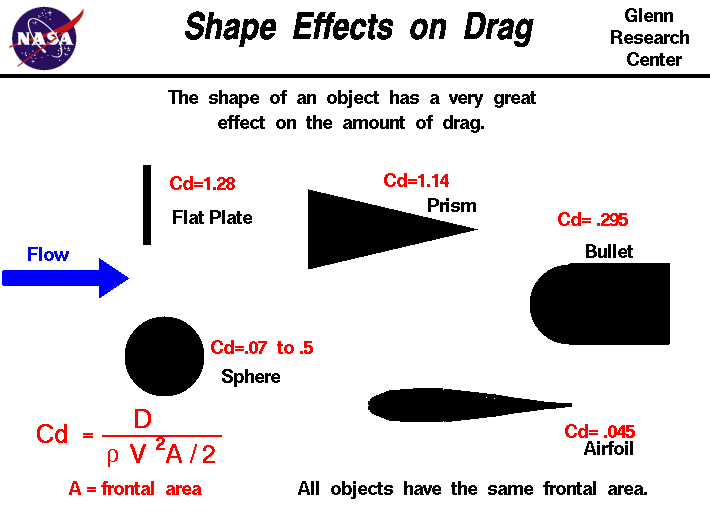
(ii) Aerodynamic drag force(Fad) : Aerodynamic drag force is the force which is required to keep a vehicle moving. There are two component of this force , one is shape drag (due to the shape of the vehicle) and another is skin friction (due to friction between air and skin of the vehicle). When the vehicle moves the velocity of air near boundary is higher than the air surrounding. The aerodynamic drag force for the vehicle can be given by Equation below-
Fad = (1/2) * ρ * V^2 * A * Cd
where, ρ = Air density, that is normally 1.25 kg/m^3.
A = Frontal area of the vehicle in m^2
Cd = Air drag co-efficient of the vehicle (It depends on frontal area, shape, protrusions, ducts, air passage etc.)
v = Velocity of the vehicle in m/s
With regard to the drag equation, the term A simply refers to area of the vehicle which feels the air resistance . Here we have considered A= 1.5m^2

| Cd for different types of vehicle- | |
| VEHICLE TYPE | Cd |
| Open Convertible | 0.5 – 0.7 |
| Van body | 0.5 – 0.7 |
| Ponton body | 0.4 – 0.55 |
| wedge- shaped body, head lamps and bumpers are integrated into the body, covered undeready optimized cooling air flow |
0.3 – 0.4 |
| Motor cycle | 0.6 – 0.7 |
| racing car | 0.2 – 0.25 |
(iii) Hill climbing force(Fhc) : Hill climbing force is the force needed to move the vehicle in up gradient. To Hill Climbing force the expression of the equation is given below-
Fhc = m * g * sinφ
where, m = Total mass of the vehicle(vehicle mass + payload) in kg
g = Gravitational constant that is 9.8 m/s^2
φ = up gradient angle or inclination angle in radian
In this case up gradient angle(φ) = 0, as there is no inclination.

- Force=Torque/ distance
- Acceleration= Inertia or Force/ mass
- Acceleration= d/dt(Speed)
- Speed=d/dt(Distance)
SIMULINK Model-

Conclusion:
Here we have designed a closed loop system to derive the speed of the vehicle based on the given parameter values.
Dividing the Motor torque by wheel radius we are able to calculate the traction force of the vehicle, then subtracting other forces from the total tractive force we have calculated Inertia of the vehicle. From there we derived the acceleration of the vehicle.
Then after that after integrating the acceleration we are able to get the speed and finally after 2nd integration we have calculated the distance covered by the vehicle.
Simulation Result:

What is Simulink model?
Simulink is a graphical programming environment developed by MathWorks for modeling, simulating, and analyzing dynamic systems. It is widely used in engineering, science, and mathematics for designing and simulating complex systems. A Simulink model is a graphical representation of a system that consists of blocks and their interconnections. Each block in a Simulink model represents a mathematical operation, algorithm, or physical component, and the interconnections between blocks represent the flow of data or signals between them.
Simulink models can be used to simulate and analyze a wide variety of systems, including mechanical, electrical, hydraulic, and chemical systems, among others. The user can create a Simulink model by selecting blocks from a library of predefined blocks or by creating custom blocks using MATLAB code. Once the Simulink model is created, the user can simulate the system’s behavior under different conditions and analyze the results.
Simulink models can be used for a range of applications, including control systems design, signal processing, image processing, communication systems design, and many more. The Simulink environment provides a powerful and flexible platform for modeling and simulating complex systems, and it has become an essential tool for engineers, scientists, and researchers in various fields.




Why Choose DIY Course
 Course work & interactions are 100% online.
Study at the time and place that suits you.
24/7 access to course material.
Learn from world-class experts in their field.